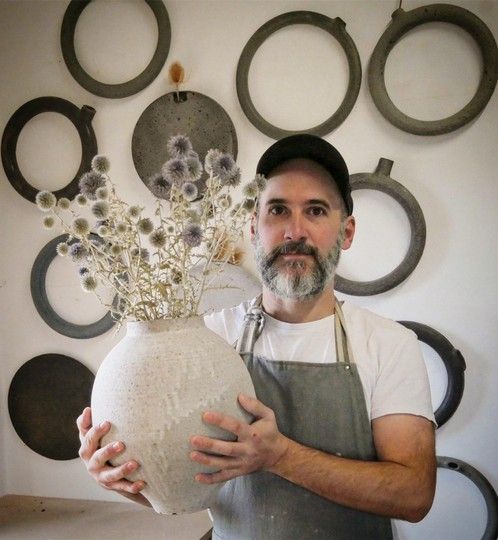
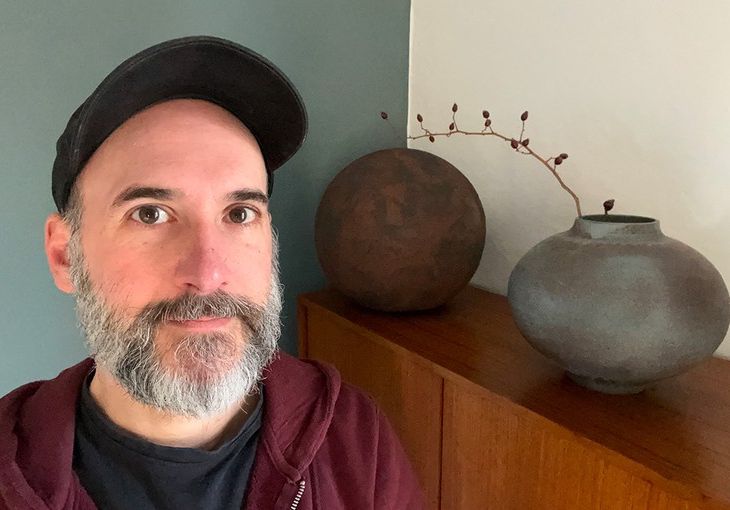
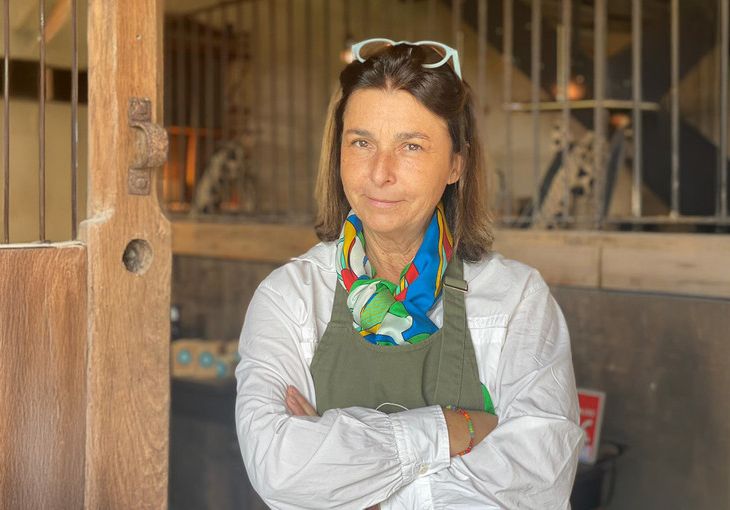
Self-taught ceramist,Nicolas Bousquet Carbó shapes clay with passion and sensitivity, striving to find the right balance in his creations. He explores textures, forms, and glazes, giving birth to almost mineral pieces that exude raw strength.
Who are you, Nicolas? Where do you come from and what has been your journey so far?
Nicolas Bousquet, ceramist: I am not a ceramist by training at all! I first studied finance, so nothing very creative. I worked in market finance for 8 years, managing currency risks. But that world and the salaried life didn’t really suit me. I needed to be independent. So I made a first shift by starting a real estate inspection company in Paris. I took courses, got certified, and it was a big challenge. For 10 years, I was my own boss.
We’re still far from your ceramist activity…
N.B.: Indeed. If finance is not a very creative field, real estate inspection is even less so. There are lots of regulations, lots of processes… it’s really on rails. I started taking ceramic classes. I wanted to do wheel throwing, to create something with my hands. I joined an association of open workshops where materials and tools were available, and I immediately liked it! I bought my own potter’s wheel which I installed in my small one-bedroom apartment and I practiced repeatedly. You should know that ceramics is quite a messy activity, so I spent more time cleaning the clay off my bedroom walls than creating (laughs)!
Is that why you chose to leave Paris?
N.B.: I was starting to feel a bit cramped in Paris, I felt like I was going in circles. I needed nature and space, so I started looking for a house in the countryside, preferably in the sun. I went on a quest for a house and found this place where I now live between Pont-Saint-Esprit and Barjac in Gard in 2019.
Just before Covid…
N.B.: Yes, it somewhat sped things up because originally, this house was supposed to be a second home to see if it would work out. It was a big change for me. Covid arrived, I locked myself in here, and never left. Today I have a real workshop. In addition to my wheel, I bought a kiln that allows me to fire my pieces and then glaze them… I am now fully autonomous in the entire production process.
What is your preferred material?
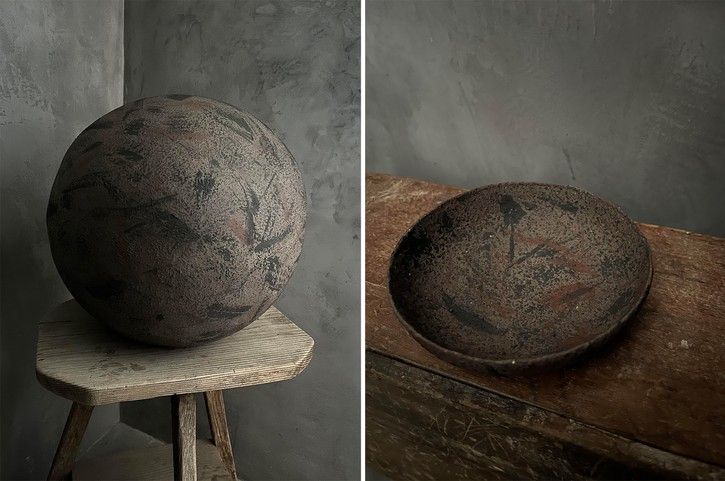
N.B.: In ceramics, there are several types of clay: earthenware, stoneware, or porcelain. I work exclusively with stoneware. I align with a Japanese-inspired aesthetic, using raw earth with dark glazes, and for that, stoneware is perfect. It’s really a material that allows working with minerality. For me, it’s always a compliment when someone says: “It looks like stone!”
Indeed, we were wondering how you manage to create all those roughnesses, craters, and small details on your creations.
N.B.: Well, all of that is work, research, and time! I developed glazes for over a year to achieve the right finish, the right shade, that slightly speckled look… All of that is chemistry. It’s work with oxides, mixing.
How do you work the color of your creations?
N.B.: From my own glazes. Glaze is a mixture of minerals (silica, alumina, feldspar…) that vitrifies during firing and coats the ornamental as well as food-contact parts of the pieces. To get colors, small amounts of metallic oxides (iron, copper, manganese…) are added. That’s why I made the chemistry analogy, because it takes countless tests to find the exact composition that suits us. Then, to get the desired color, there are other difficulties like firing temperature or the thickness of glaze applied on the piece. It’s very complex and not always obvious.
Have you ever had failures?
N.B.: All the time (laughs)! Ceramics is a craft that teaches patience and humility. There are so many parameters to consider: materials, drying, firing… time, simply! Failure is an integral part of this art. Sometimes a huge crack appears on a piece at the end of firing, and then I have two options… either destroy it or do kintsugi (a Japanese restoration technique using joints traditionally made with gold powder).
What kind of pieces do you produce?
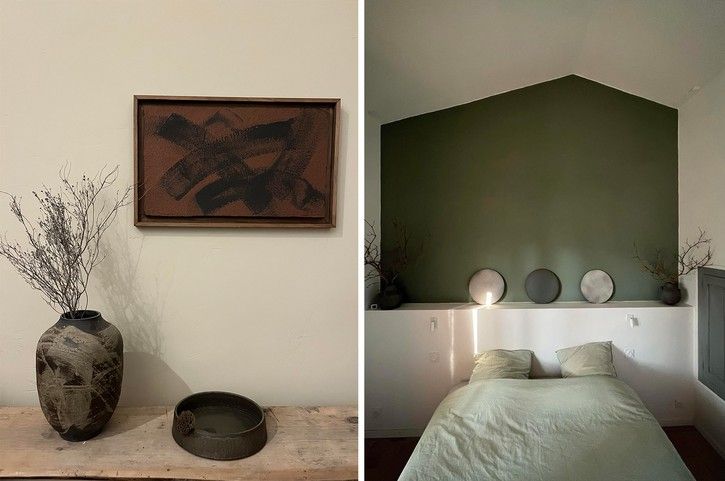
N.B.: Obviously utilitarian objects like tableware (plates, bowls, cups…), but I am increasingly turning to sculptural and decorative pieces. At first, I made 2D discs and then moved to 3D by developing spheres. It’s a bit more complex technique. You can’t make these shapes on a wheel, so you have to use other methods. I then use modeling and slabs that I make using a slab roller – it’s like a pasta machine – to create these 3D sculptures.
What does a typical day look like for a ceramist?
N.B.: That’s the magic, there is no typical day! One day I do wheel throwing, the next I do trimming (removing excess clay from the base of thrown pots), the day after I work on a slab sculpture…
What stirs a particular emotion in your work?
N.B.: It’s opening the kiln. It’s like Christmas morning when you arrive at the foot of the tree and discover your gifts. But what I especially love to do is shape the piece. Being in the creation of form, doing wheel throwing or stamping (a technique consisting of applying clay, in slabs or small pieces, onto a mold).
Where can we buy your creations?
N.B.: Directly at the workshop where I have a small showroom, or otherwise via Instagram. I can also produce on order.
De La Cour Au Jardin is a real estate network specializing in charming properties, and we know the intimacy one can form with their living space. What made you choose this house and not another? What is your relationship with it?
N.B.: I had many criteria at the start. I wanted a stone house, a beautiful view without overlooking neighbors, calm, and nature. Like many Parisians, I started looking in Perche for proximity to the capital. I found it bucolic, with hedgerows, but not wild enough for my taste and too humid for me. I was born in Aude, so the sun is important to me (laughs). So I turned to Ariège. A beautiful, wild region, but unlike what I had imagined, there were few stone houses. I continued searching in the Cévennes, then Ardèche. During my stay in Ardèche, friends told me to check out the Cèze Valley in Gard. I scrutinized listings and finally came across this house. I went there and fell in love! Without even going inside, I knew it was the one. The environment, the view, the building… it was exactly what I was looking for.
We have a favorite question we ask all our guests: what is your definition of the art of living?
N.B.: I had never asked myself that question… (he thinks) I don’t know if this answers your question, but one day I told myself that we should stop depriving ourselves of using beautiful things every day for fear of damaging them. Even though I’m a ceramist, for a long time I didn’t eat on the plates I created. I sold them but didn’t use them. For me, the art of living is coherence between who we are and what we love. There’s no point in having beautiful clothes if they just stay in the closet. Beauty and fragility