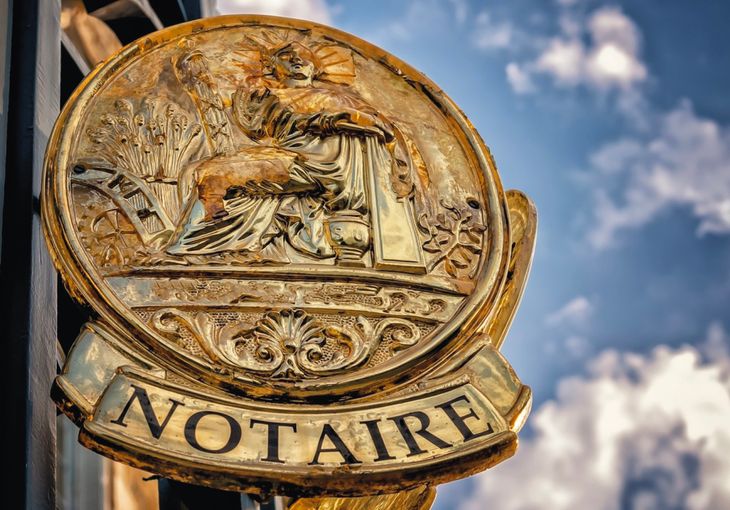
Technically speaking, a notary is a public officer appointed by the Minister of Justice, entrusted with a public service mission. But behind those dry and somewhat opaque words lies a professional of vital importance at many stages of our lives — not only in real estate transactions, but far beyond. In love, in life, in death, the notary plays a key role. We sat down with Maître Béatrice Codron, notary in Saint-Chéron, Essonne.
Maître, looking back, we are witnessing a real resurgence of the notary's role within families and matters of wealth. Has the notary become an indispensable family figure once again?
Béatrice Codron: Yes, that's quite right. That said, within our practice, family has always been at the heart of everything we do. We have been accompanying the same families across five generations — that is something of a hallmark for us. And to answer your question more precisely: one of the notary's key advantages is national jurisdiction. When you have known a family for a long time, they appreciate dealing with the same person, the same practice, whenever an investment or life decision arises.
What is your role in supporting families?
B.C.: Our primary role is to advise. In our practice, we are two associate notaries alongside employed notaries — around twenty people in total — and advisory duty is something we all hold very dear. It is the cornerstone of what we do.
Interestingly, our CEO, Isabelle Larochette, spent part of her earlier career as a notary's clerk in Bourges, and she noticed how often clients used the phrase "my notary" — which says a great deal about the relationship that builds over time. Why and how can a notary be involved at every stage of a person's or a family's life?
B.C.: Clients come to us for everything. We receive emails every day on all sorts of questions. Early in adult life, people often consult us about living together without formal commitment. Then, at some point, they realise that arrangement may no longer be the best fit, and they ask what the right next step might be. Depending on each person's profile and deeper wishes, we present the available options — civil partnership (PACS), marriage, a will — and guide them accordingly.
Then, once a couple is settled and has children, they come back for everything related to protection: wills, gifts. Those questions come up several times a day at our practice, which is a clear sign of how much the French worry about protecting their loved ones. You sense a real anxiety. How do you explain it?
B.C.: Today there is a genuine sense of fear and concern, and it expresses itself as a strong desire to pass things on. But taxation in this area can be very high, and that worries a great many French people. Of course, clients understand that it is entirely normal to pay something when transferring wealth. But the figures have become absolutely enormous, with tax allowances that are no longer aligned with current property values. Raising those allowances to make it easier to pass on more to one's children seems like a reasonable step.
And at the centre of all this — the family home…
B.C.: Yes, absolutely. "How can I pass my property on to my children? How can I preserve and transmit a family home?" — these are questions we hear constantly, because the notion of the family home is deeply meaningful in France. It is part of our Latin roots. We can find several generations living under one roof, in a home adapted to different generations — much like you see in Italy, Spain or Portugal. Grandparents on the ground floor, children and grandchildren above… people are profoundly attached to that. We are Latins, and family holds a very particular place in our culture.
Ultimately, by being present at every stage of a family's life, you are in some ways the guardians of the family story…
B.C.: I want to stress this: our clients do not come to us wanting more — they come to us wanting to hold on to what they have, to remain as in control as possible. And as people age and retirement approaches, new questions arise. The practice is called upon again for matters of future protection, general power of attorney. "I trust my children completely and want them to be able to help me — how do I arrange that?" "If I have a stroke, what medical decision-making power do my children have?" "If something happens to me, how can I make things easier for my family?" These are entirely legitimate concerns, and we are here to answer them.
Advisory work is really the notary's primary mission, isn't it?
B.C.: Absolutely. Clients regularly ask what they owe us at the end of a consultation. At our practice — as at many others — advice is free. That is our approach, because the very essence of this profession is precisely that duty to counsel. For us, kindness and empathy are the pillars on which our client relationships are built.
Do you observe — as we do in real estate — a growing desire for a change of life? A wish to reprioritise, to take a new path?
B.C.: Enormously so! We are lucky to be in the Chevreuse Valley, which offers a beautiful, dynamic, very green environment. Within the practice, we have clearly seen a migration from Paris to our region, but also from our region out to the provinces. Every day we formalise life changes — sales and purchases from one place to another, all across France.
Which regions attract your clients most?
B.C.: It isn't necessarily the traditionally popular tourist regions. Many are drawn to Corrèze, Creuse, Normandy and — of course — Brittany, but often further inland. I take my hat off to those who commit to a change of life. It takes real courage, because it truly turns daily life upside down — economically, certainly, as their financial situation will inevitably be different. Some people are prepared to sacrifice a salary in exchange for a better quality of life. We also see whole family migrations across generations: I have in mind a family — parents and children — who all moved to the same village, into two separate houses, to live better and stay close while respecting each other's privacy.
Thank you, Maître Codron, for these insights, which confirm so much of what we see day to day. To close, you won't escape our favourite question: what is your personal definition of the art of living?
B.C.: I practise Reiki* — it is quite a challenge for me. So if I had to define the art of living, I would say it is feeling well, both personally and professionally. Family must be very present, alongside respect for others, kindness and empathy.
*Reiki is a Japanese healing method based on balancing a patient's inner energies through the practitioner's hands.
— — —
Notarial Practice — CODRON Béatrice & CODRON Benoît