Thirty years in communications and art direction, followed by a deliberate turn toward creation. Today, Anne Mondy is a visual artist, interior decorator, and set designer. A life led on instinct, between studios, exhibitions, and collector's cars wrapped in paper. A portrait.
Anne, can you tell us about your career path?
Anne Mondy: I'm a visual artist, designer, and interior decorator — it's a second career, the famous midlife crisis. Before that, I spent thirty years in communications, art direction, and the press. And then, at a certain point, I no longer felt aligned with that work, which had been a wonderful period of my life. I think I always had an artistic streak that went completely untapped. I've been making collages since I was six. So I thought, why not? And I was right, because little by little it all opened up onto interior decoration and set design.
What was the turning point?
A. M.: It started with a project I walked away from midway through: the reopening of the Molitor swimming pool. I was the art director, and I realized I was no longer at all aligned with the way of working, with what was expected of me. I'm an artist at my core — when I'm asked to do art direction, I really do art direction. At almost the same time, I moved to Bordeaux. I felt like I was going in circles in Paris. And since I'm raising my daughter on my own, I told myself: actually, I'm free of everything. I've changed careers, I can do this from anywhere. It was a realization, a kind of freedom.
Collage really is the backbone of your work. Where does this technique come from?
A. M.: My mother was a model, a fashion enthusiast who bought every women's magazine. I always lived surrounded by that pile of magazines. I watched her cut out images to note what she wanted to buy, and I took it up fairly early myself, with a glue stick. Alongside my work, I often made collages for birthdays and special occasions.
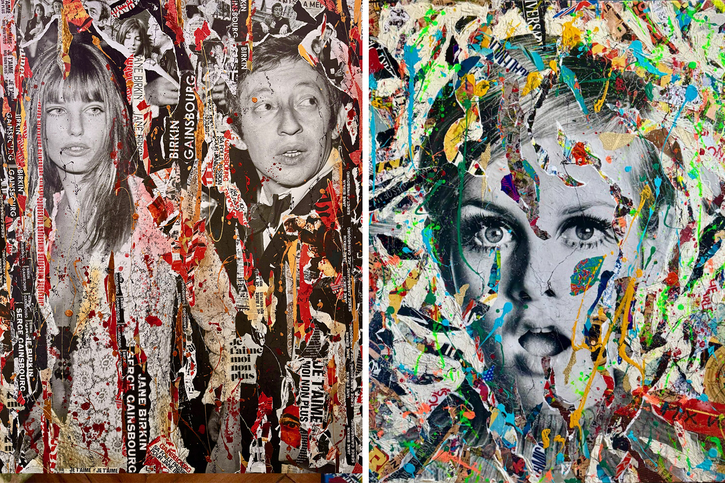
My distinctive trait, which I developed much later, is to tear rather than cut. I love tearing — it's very freeing, and surprising things come out of it. It's all about layering, the staging of colors and typography. A piece is finished when I've spent three days in front of it thinking, "something's missing there" or "that's too much there."
I work in a completely artisanal way: I cut out all my little scraps of paper, sort them, and arrange them by color in my studio. And I hunt down a lot of posters and old newspapers — the texture of old paper is incomparable, it can completely elevate a piece. There's no Photoshop, no AI. Everything is done by hand, scrap by scrap. It's my signature and I'm very proud of it.
You're also an interior decorator and set designer. How did that dimension come about?
A. M.: I immediately project myself into a space — I realized this because I've moved a lot. My father, who was an actor and director, had long seen me as a theater set designer. In a different way, that's more or less what I do.
It all really began when I bought 6,000 square meters of land in Essaouira, Morocco, and built my house from A to Z — the plans, the interior, everything. Unfortunately, Covid came along, I couldn't oversee the work for more than a year, and in the end it was a complete letdown. I redid everything. But the experience was absolutely wonderful.
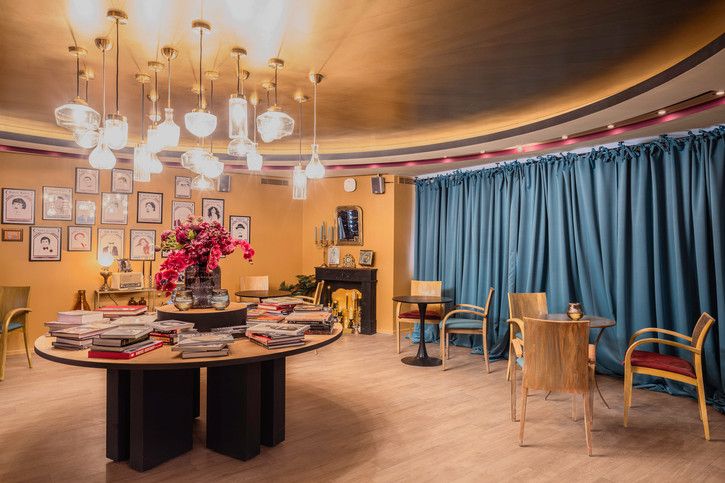
It was through that house that I met the director of the Théâtre Actuel La Bruyère, who had rented it from me and who said: "Anne, if I ever renovate the theater one day, I want you as my decorator." A year and a half later, she called me. I transformed everything in a month, on a very tight budget, hunting for finds and recycling a lot. Those are the most rewarding challenges.
Among other things, you've created works on collector's cars. How did that happen?
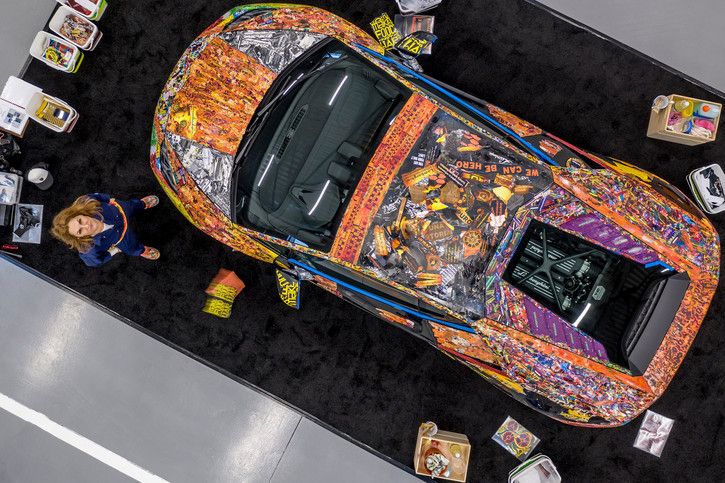
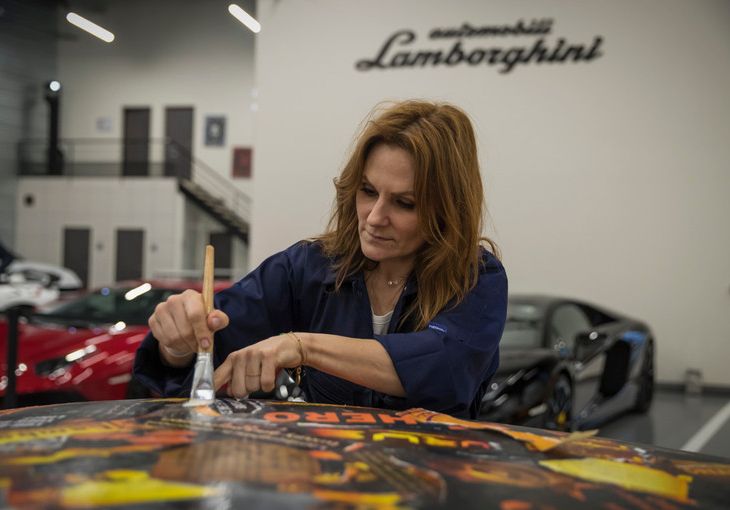
A. M.: Lamborghini Italy was looking for an artist for the opening of a major dealership in the Southwest — something artistic, exceptional, never seen before. They looked at my collages, and my press agent put my name forward, saying: she can create a composition on a Huracán and finish the piece live in front of 800 people. I thought it was absolutely brilliant.
In the meantime, we realized it had never been done anywhere. I'm the first artist in the world to have covered a car in little scraps of paper. It took me a week to do the bulk of the work, then I created an entire fender live. Across the whole car, I tell the story of Ferruccio Lamborghini — black and white, the tractors, the origins. There's always a story.
That Lamborghini caused quite a stir. I was then contacted for the 60th anniversary of the Jaguar E-Type: that time I did the entire car live, on the theme of the Swinging Sixties. Then the Fiat 500… And now I'm about to do an old Mercedes.
What was the most memorable commission?
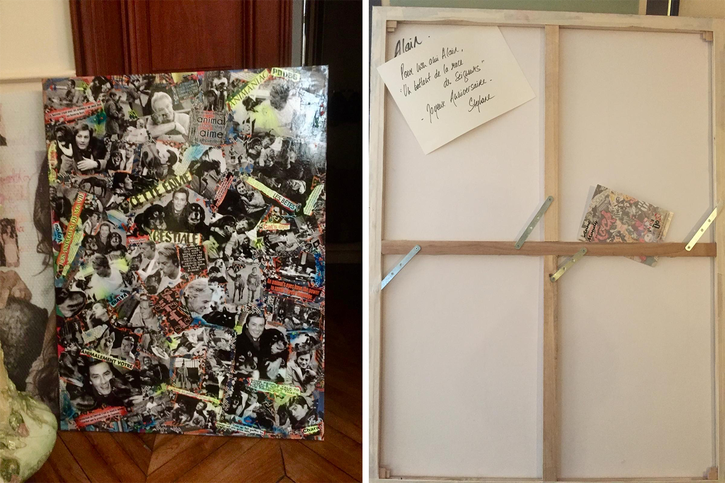
A. M.: A commission for Alain Delon! It was a very close friend of Alain Delon who, for his 80th birthday, wanted to give him a work featuring all his departed animals. They sent me photos of the graves on his property in Douchy. It's a 100 × 100 format, with lots of animals — and their headstones, of course.
Suffice it to say the subject called for some thought. He's not just anyone, and the work had to live up to it. It's not just a patchwork — my work is about having cohesion, colors, phrases. I did it, and I believe he was very pleased. With one reservation: I'd slipped in a word about the male — "male" in the sense of animal masculinity — and he didn't like it. I found that surprising coming from him, but so be it.
What gets you out of bed in the morning?
A. M.: My coffee, first of all. And then, creating. I'm hugely creative — even without a commission, even without an exhibition planned, I create. When I'm in the countryside, I do a lot of research: I really dig into my subjects, because if I have a commission about Apollo, for instance, I don't want to put something foolish into a piece. It happened to me once on a piece about rock music, where I'd included someone the person didn't recognize. Ever since, I double-check.
My greatest pleasure is the moment I'm in front of my canvas. I don't meditate at all and I'm rather hyperactive — but there, I enter a bubble. I put on music, sometimes the TV in the background. And when I tear my papers and arrange them, that's my moment. I never tire of it. I also know how to stop for two months to rediscover that desire, that inspiration.
And finally, our signature question: what's your definition of the art of living?
A. M.: Having time. Time to live, time to enjoy. It's perhaps a luxury, in fact. Sitting down in your garden, on a café terrace. Time is in short supply. And it's an art of living that I don't practice at all — but what a joy when it does happen. That's the most spontaneous answer, and I'm sticking with it.