Les Culs Salés: salt harvesters of Guérande, a thousand-year-old art carried by the water
Les Culs Salés: salt harvesters of Guérande, a thousand-year-old art carried by the water
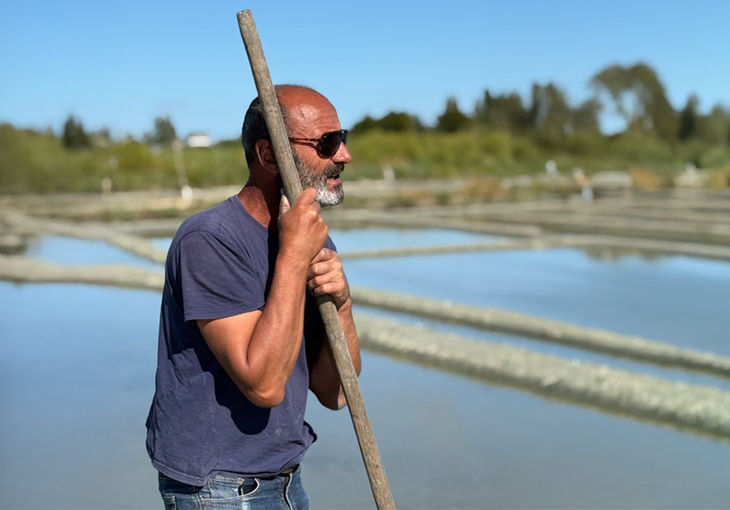
Guillaume and Anne left Nantes to settle in Batz-sur-Mer, where Guillaume became a salt marsh worker — a “paludier” — at the age of 50. Together they founded Les Culs Salés (“the Salty Bottoms”, the centuries-old nickname given to Guérande’s salt harvesters) and hand-harvest an exceptional salt using techniques more than a thousand years old. We met them at the edge of the salt pans, somewhere between coarse salt, fleur de sel and the Breton art de vivre.
Are you a paludier from father to son, or is this a more recent story?
Guillaume: Not at all — I started the year I turned 50! But today, my son is a paludier in his own right. So it’s not even a matter of handing down the trade: my son is the second generation.
How did it all begin?
Guillaume: We were living in Nantes, and both Anne and I, each on our own side, had been coming to this area since we were children. When we settled in Batz-sur-Mer, our neighbour was a paludier. I asked him to teach me the trade, which he very kindly did. One thing led to another, and we took over several salt pans. And then one day, Anne and I said to ourselves: why not launch Les Culs Salés? It’s the centuries-old nickname for Guérande’s salt harvesters — the nickname we’ve been seasoned with for a very long time.
What did you do before?
Guillaume: At the very beginning I was a journalist, then a copywriter. I’ve done quite a few things in my life, including radio in New Caledonia. Later, I set up my own writing agency. But ever since I was a child, I’d wanted to work the salt marshes. It’s a wonderful profession, in an incredible place — a landscape shaped by the paludiers themselves. If we have these extraordinary scenery today, it’s thanks to men who have been working with shovels, practically by hand, for over a thousand years.
What does a typical day look like for a "paludier"?
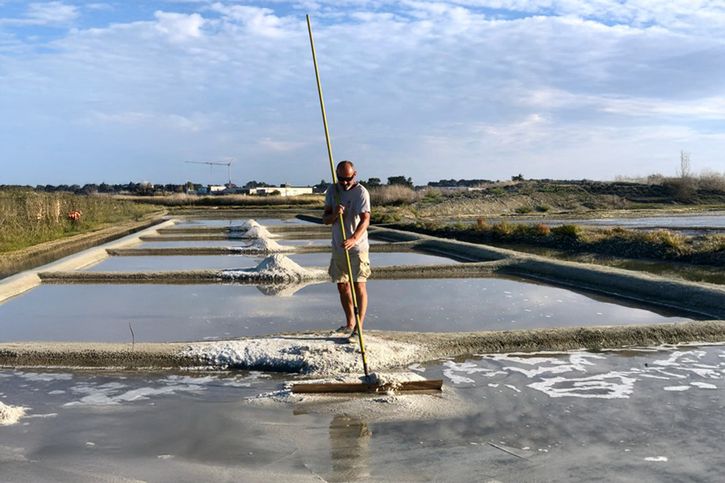
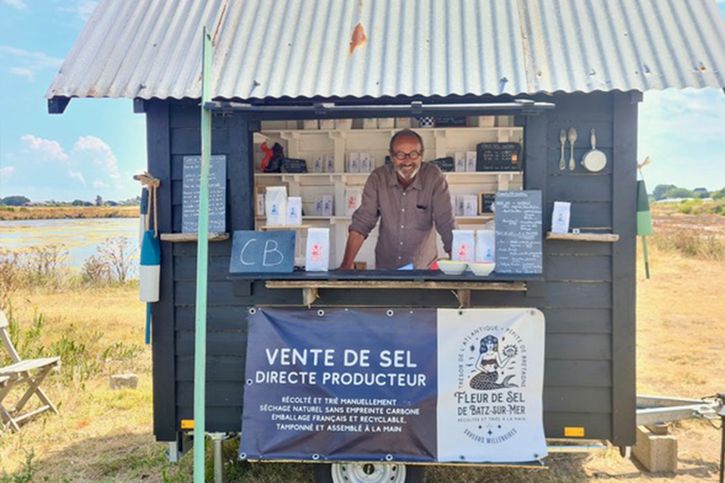
Guillaume: My days start at around 5 a.m.: I go out to collect the coarse salt, the salt that forms on the clay at the bottom of the water. That keeps me busy until 10 a.m. Then we set up our sales stand — a little roadside caravan on the marshes. In mid-afternoon, the fleur de sel forms on the surface of the water. We harvest it, and at around 5 p.m. we give a free tour of the marshes. That takes us to 8 p.m. Alongside the harvest itself, there are plenty of other tasks — above all, managing the water in the salt pans. The one guiding principle is to keep the water moving at all times, adjusting the flow so there’s never too much water, but never too little either. A great deal of monitoring work.
In Guérande you’re called “paludiers”, whereas on the Île de Ré or in the Mediterranean the word is “saulnier”… what’s the difference?
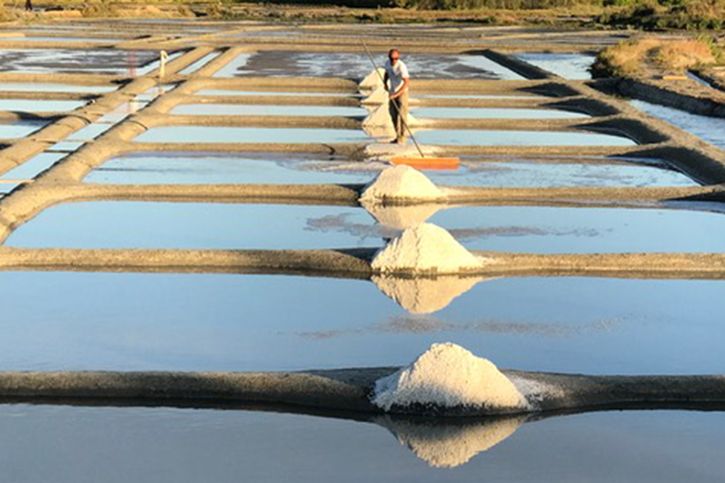
Guillaume: It’s the same principle! Paludier comes from the old Latin palud, meaning marsh. In Brittany we say paludier, and everywhere else, saulnier [from the Latin sal, for salt]. On the Île de Ré, for instance, the layout of the marshes isn’t quite the same: they harvest in carreaux, which are tiny. Here, we call ours œillets, and they’re much bigger — each œillet measures around 70 square metres.
Tell us about your tools. We see you with long poles — do you scrape the bottom?
Guillaume: Absolutely not! That tool is called a las: a five-metre handle with a wooden blade at the end. It’s actually a tool for making waves. The salt forms on the clay, under the water. If we scraped it, it would get dirty from rubbing against the clay, and we’d damage the bottom of the œillets. So instead we create waves that roll the coarse salt towards the ladures, those small round clay platforms where we lift it out of the water. We leave it to drain for two or three hours, then wheelbarrow it over to the trémet, a storage platform beside the salt pan, where we build the big heaps known as mulons.
Anne: For the fleur de sel, the tool is called a lousse à fleur. It’s like a flat stainless-steel skimmer with raised edges, so the fleur doesn’t fall off the other side. You really just skim the surface of the water — the idea is never to touch the clay, otherwise you spoil the fleur de sel. Then we rinse it to remove any impurities, sort it, and leave it to drain for two years in our salorge — the salt barn.
Two years of draining! Do you never dry your salt?
Guillaume: No, we don’t want to dry it, because that harms its qualities. The big traders do, because they have to meet the food industry’s specifications, with maximum and minimum moisture levels. Not us: we only work with delicatessens, restaurant owners, charcutiers and private customers.
How much salt do you produce?
Anne: Guillaume works 26 œillets — 26 production units. In an average year, that’s around 35 to 40 tonnes of coarse salt, and 2.5 to 3 tonnes of fleur de sel.
“Louis XIV would have no salt but Guérande’s […] he even found it smelled of violets.”
What makes Guérande salt so special?
Guillaume: What makes it so special is that it’s seriously good! (laughs) It’s only salt, but it’s very, very good salt. We’re in a clay area with impermeable soil, wedged between the Vilaine to the north and the Loire to the south. That creates a biologically rich marine environment. As a result, the seawater from which we extract our salt is full of mineral salts. And our production technique, on clay, means the salt also takes on trace elements. So it contains less sodium chloride — it’s less salty, with no bitterness. That’s why Louis XIV would have no salt but Guérande’s — he even found it smelled of violets. And it’s true that when it’s fresh, there are aromas like that, somewhere between butter and violet.
The other special thing is our Breton climate: as soon as the salt is there, we take it out of the water — if it rains, it melts! So it never fully crystallises. It’s crunchy rather than hard, and the moment you put it in your mouth, it melts and seasons instantly. That’s why it’s so prized in cooking.
What is it about this trade that fascinates you so much?
Guillaume: Its history! The first written record of the Guérande salt pans is the sale of a salt pan, recorded by a monk in a book that still exists today, the Cartulaire de Redon. That book, which dates from the year 854, describes a salt pan exactly as it is today. To me, that’s the most marvellous thing of all: knowing that we’ve been working this way for more than 1,200 years.
You work in direct contact with the elements. Does climate change worry you?
Guillaume: Yes, clearly, because weather events are more violent than they used to be. There are several dangers. First, the increasingly fierce winter storms, which can damage the dykes protecting the marshes from the sea — all of this is extremely fragile, it’s only clay. Then there’s the danger during the season: ever-stronger thunderstorms. Rain is our enemy. If it rains too much, we make no salt. It happened in 2024: it rained all summer, and we made no salt at all. In those years, we live off our reserves — a bit like a farmer, in the end. And in fact, we’re now registered with the MSA [the French agricultural social security scheme] — we’re farmers now. In the old days, paludiers were affiliated with the mines!
Is harvesting the biggest part of the job?
Guillaume: No, the biggest part of the job is maintaining the marshes. In winter, from February onwards, we have to clear out the silt — there are tonnes of it. We have to rebuild the little clay bridges damaged by the weather. Where our salt pans are, I’d say we shift more silt by weight than salt.
Can people visit your marshes?
Anne: Every day at 5 p.m., we offer free tours, because everything is expensive these days, and some families simply don’t have the budget. Rather than charging for a visit, we’d rather people came to discover the marshes and how salt is made — and afterwards, depending on their budget, they buy a little salt, or not. Guillaume even built a scale model this winter to explain how a salt pan works!
How should Guérande salt be used in the kitchen?
Anne: Coarse salt is for cooking — everyone knows that. Fleur de sel is for seasoning after cooking, at the table. You never heat fleur de sel: it would melt, and you’d lose everything that makes it special. One tip: if you’re preparing a tomato salad in advance, don’t salt your vinaigrette — add the fleur de sel at the very last moment.
Guillaume: Except on certain dishes! Marrow bones, pot-au-feu, all the winter classics: there, you need coarse salt, for the crunch. It’s far better. After that, it’s each to their own taste.
You also offer some original blends…
Anne: We had fun creating a few blends that simply made us happy, using slightly unusual organic spices — we only use organic, because we don’t want to add anything whose origin we don’t know. We have a fleur de sel with Timut pepper, and our favourite: smoked fleur de sel. At first, we knew nothing about it! We had a little smoker, and we smoked and smoked… it certainly smelled smoky, but it had no taste at all. Until Guillaume met a salt chemist, who very kindly explained that salt is a mineral: you can smoke it for 300 years, it will smell of smoke but never take on the taste. You need something organic. So we grind black pepper, mix it with the fleur de sel, and a friend in Le Conquet, just above Brest, who runs a smokehouse, smokes the salt and pepper together for us. It’s the pepper that takes on the smoky taste and coats the whole blend. People keep coming back — it’s incredible!
Guillaume: And his smoking is magical: he smokes over wood, with seaweed he gathers at Le Conquet, facing the island of Ouessant, and peat. It gives a wonderfully pleasant smoke.
And finally, our signature question: what is your definition of the art de vivre?
Guillaume: Living in Batz-sur-Mer — more precisely in Roffiat, where we live — and not bothering other people with your convictions.
Anne: We’re lucky enough to live in a privileged environment. What I wish for everyone is to live in harmony with the environment around them. And in good company — here, it’s pure happiness.
Guillaume: There’s something about the paludiers that really captures the art de vivre: it’s a physical, demanding trade — the winter work is hard, the summer work too, every morning, every evening, it’s repetitive. But there’s a real solidarity among the paludiers. Some jobs are done as a team, on a volunteer basis. And there’s always good cheer!
Les Culs Salés
Website:les-culs-sales.com
3 Place Porhgway — 44740 Batz-sur-Mer Direct sales or online shop — and free tours of the salt pans every day at 5 p.m.